5 Surprising Truths Shaping the 2026 US-Iran Conflict

Beyond the Carpet Bombing:
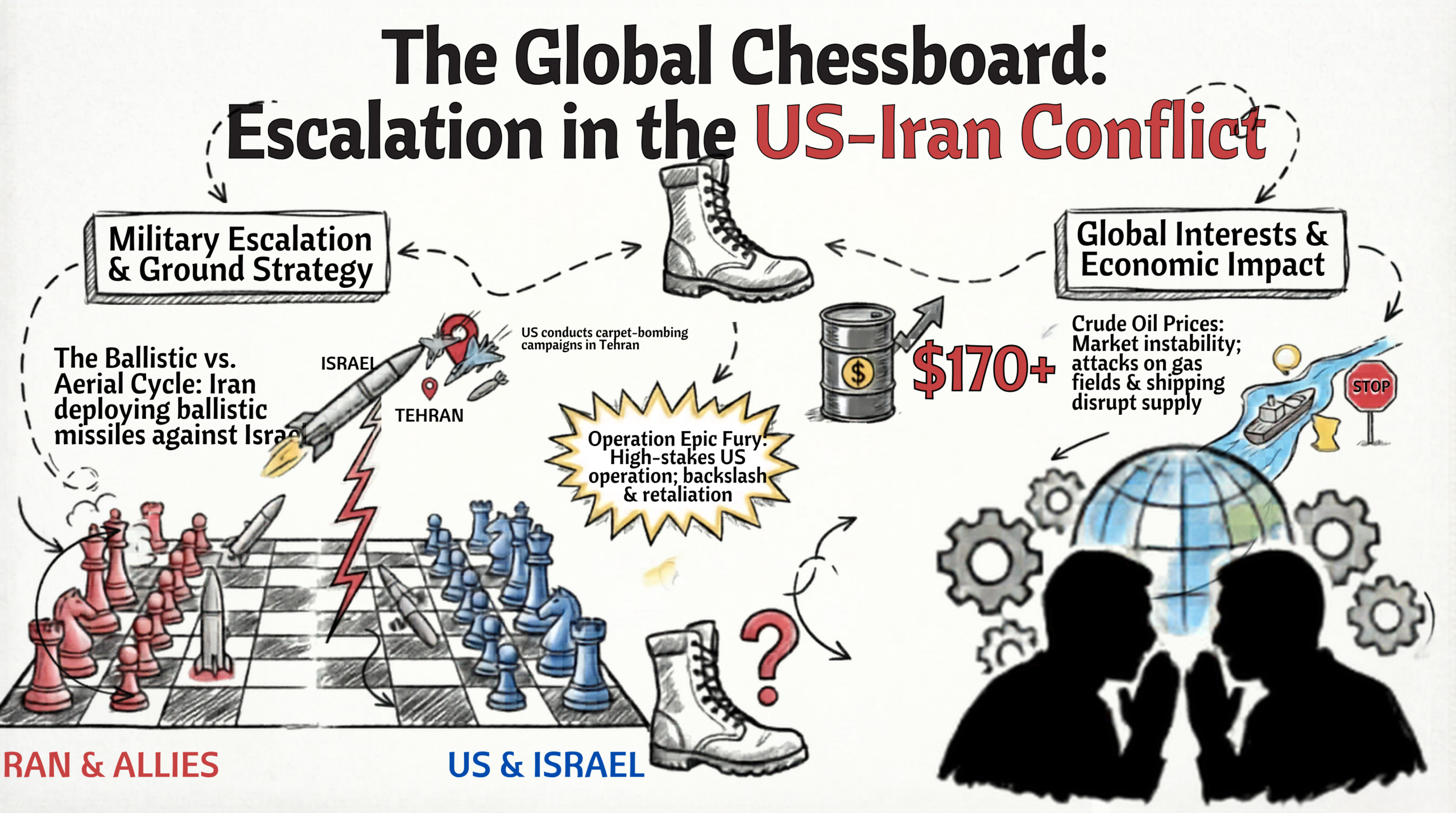
By March 2026, the fires over Tehran have become a permanent fixture of the evening news. To the casual observer, the conflict looks like a traditional display of American kinetic dominance: B-21 Raiders engaged in the “carpet bombing” of Iranian infrastructure while Tehran responds with desperate arcs of ballistic missiles toward Israel. But the smoke and the “Smart Bombs” are a distraction. Below the surface of this high-octane violence, a quieter, more lethal power struggle is unfolding—one where the West’s technological hubris is being dismantled by a decentralized, “Smart Thinking” resistance.
The crisis has reached a terrifying equilibrium. We are witnessing a collision between the old world of overwhelming firepower and a new reality of asymmetrical resilience. While Washington clings to the doctrine of “Operation Epic Fury,” the ground beneath the global order is shifting. To understand why the world feels like it is tilting off its axis, we must look at the five truths that the headlines are missing.
1. The Shadow Play of Russia and China

While the U.S. and Iran trade blows, the war’s ultimate trajectory is being steered from the quiet rooms of Moscow and Beijing. This is no longer a regional dispute; it has morphed into a proxy battlefield for global hegemony.
As reported by analysts like Akash Banerjee, these global powers are “quietly shaping” the conflict to ensure the U.S. remains trapped in a strategic quagmire. Russia and China aren’t seeking a ceasefire; they are providing the diplomatic cover and potentially the satellite intelligence that allows Iran’s ballistic missiles to find their marks despite U.S. interception nets. By keeping the American military bogged down in a costly, open-ended engagement, Moscow and Beijing are accelerating the transition to a multi-polar world where U.S. military reach is no longer the final word.

“The conflict is less about the fate of Tehran and more about the exhaustion of the American empire, with Russia and China acting as the silent architects of a new global order.”
2. Iran’s Strategic “Olive Branch” and the Indian Lifecycle
In a masterstroke of tactical isolation, the Iranian President has successfully driven a wedge into the U.S.-led coalition. While the U.S. expected a regional “crusade” against Tehran, Iran offered a calculated peace to its neighbors.

“Iran will not bomb the Gulf nations unless provoked.” — Iranian Presidential Statement, March 2026.
By refusing to strike neighboring Arab states, Tehran has made it politically impossible for Gulf nations to offer the U.S. the logistical support required for a full-scale ground invasion. Furthermore, Iran is picking its friends with surgical precision; reports of “Iran Allow Indian Ship” to pass through contested waters show a regime that is wounded but still strategically agile. By protecting the economic interests of neutral powers like India, Iran ensures it isn’t completely isolated, even as its capital burns.

3. The Failure of “Operation Epic Fury” and the Ground War Trap
The Trump administration’s “Operation Epic Fury” was sold as a decisive strike to end the Iranian threat forever. Instead, it has become a case study in intellectual arrogance. The U.S. military assumed that $2 million “Smart Bombs” could defeat a centralized state. What they found instead was a “headless and wounded” resistance that thrives on decentralization.
The “ballistic backlash” from Iran has been far more resilient than Pentagon war games predicted. The U.S. is finding that you cannot bomb a decentralized idea into submission. As the military struggles to overcome this backlash, the “boots on the ground” strategy—once championed as the final solution—has revealed itself as a lethal trap. The Iranian defense hasn’t collapsed; it has simply evolved, leaving U.S. forces punching at a shadow that refuses to stay down.
4. The “Invisible Nuclear Bomb” of the Strait of Hormuz

The most devastating weapon of 2026 isn’t a warhead—it’s the “Invisible Nuclear Bomb” of economic annihilation. By targeting global energy arteries, Iran has achieved mass economic destruction without a single radioactive cloud.
The hit on Qatar’s gas hub, the world’s largest, has sent shockwaves far beyond the Middle East. As synthesized by Dhruv Rathee and Ankit Sir, this isn’t just a “gas price hike”; it is a domestic stability crisis for neutral nations.

- Crude Oil Prices: Surged past $170 per barrel in Oman, crippled by the Strait of Hormuz blockade.
- The Qatar Hub: A strategic missile strike has effectively halted global LPG supplies.
- The Indian Crisis: The resulting “LPG Crisis” in India has sparked domestic turmoil, proving that the “Invisible Nuclear Bomb” strikes the kitchens of Delhi just as hard as the markets of New York.
5. The High Cost of a “Headless” Resistance and the Netanyahu Mystery
The most jarring “surprising truth” of this conflict is the absolute chaos within the leadership of the primary combatants. On one side, a joint CIA-Mossad operation reportedly “got” Ayatollah Khamenei, decapitating the Iranian clerical leadership. Yet, the Iranian military continues to fire, guided by a decentralized “Smart Thinking” doctrine that doesn’t require a central command.

Equally destabilizing is the mystery surrounding the Israeli leadership. Rumors of the death of Benjamin Netanyahu or his disappearance have left the U.S.-Israel alliance in a state of paralysis. If Netanyahu is indeed gone or incapacitated, the “Secret War” has effectively left both sides “headless.” This vacuum has not led to peace; it has led to an uncontrolled escalation where no one is left with the authority to blink.

The Endgame of Hubris
As we move further into 2026, the question is no longer who has the better technology, but who has the greater resilience. The U.S. may possess the “Smart Bombs,” but Iran’s “Smart Thinking” and the global economic fallout of $170 oil have rewritten the rules of engagement.

Can any global power truly claim victory in a world where an “Invisible Nuclear Bomb” can bring a superpower’s economy to its knees? We are witnessing the definitive end of traditional military dominance, replaced by a chaotic, decentralized era where the wounded are often the most dangerous players on the board. One thing is certain: the world that emerges from the smoke of Tehran will look nothing like the one that entered it.