BAWANJAN BARUN
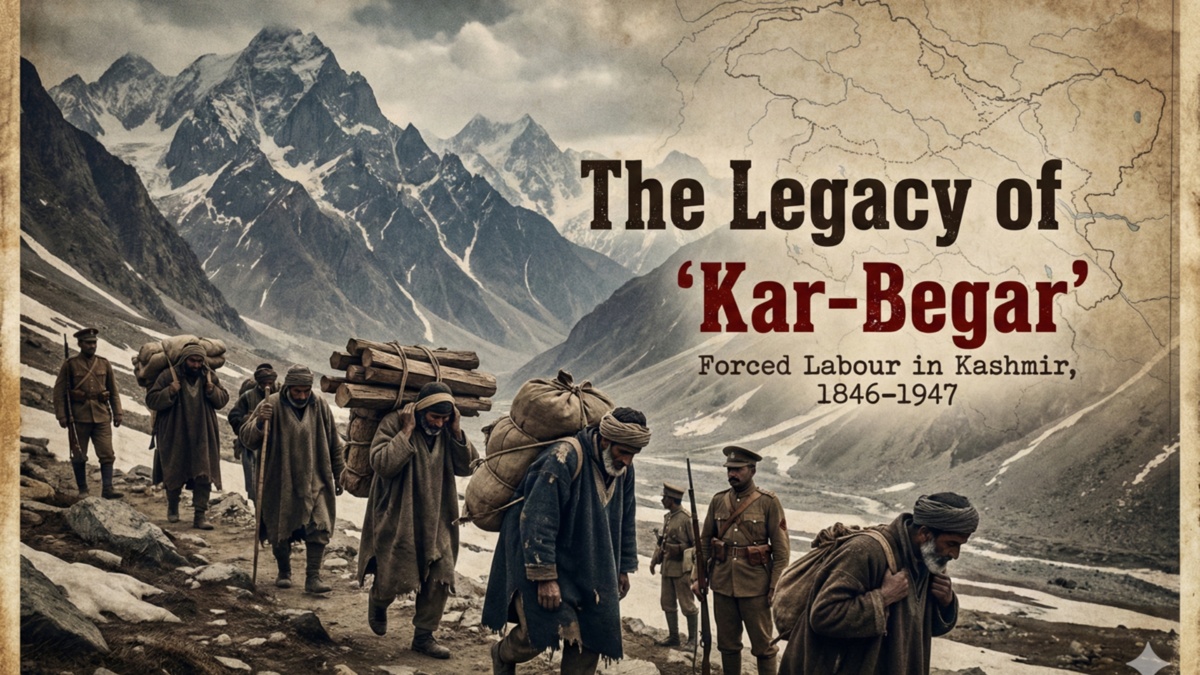
The Legacy of “Kar-Begar” Forced Labour in Kashmir, 1846-1947
An Idiom as a Historical Record
In the Kashmiri language, the idiom ‘Bawanjan Barun’ survives not merely as a linguistic curiosity, but as a profound historical artifact. It is a phrase steeped in generations of trauma, preserving the memory of a state-sanctioned system of oppression. This monograph dissects the origins and realities behind this enduring expression, revealing its deep and tragic connection to the ‘Kar-Begar’ system of forced labour that defined the period of Dogra rule in Jammu & Kashmir.
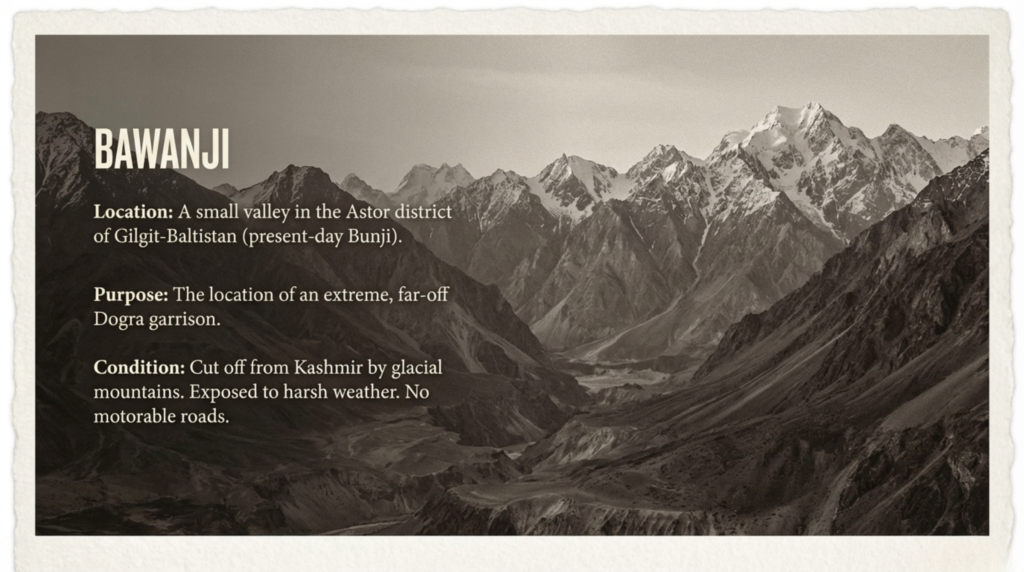
Literally translated as “sending to Bawanji as ultimate punishment,” the idiom functioned as a powerful tool of intimidation. It was wielded by the cruel tax collectors and unscrupulous officials of the Dogra Administration to frighten the impoverished peasants of Kashmir. The threat of being sent to Bawanji was synonymous with a sentence of “certain death,” a consequence for the inability to pay state taxes.
This monograph’s central thesis is to demonstrate how the ‘Kar-Begar’ system, institutionalized between 1846 and 1947, operated as a systematic tool of oppression primarily against the Kashmiri Muslim populace. The brutal realities of this forced labour—its discriminatory application, its calculated economic devastation, and its horrific human cost—are preserved with chilling clarity in the collective memory through this enduring idiom. The geopolitical anxieties that gave rise to this system provide the necessary context for understanding its implementation.
Geopolitical Context: The Establishment of Dogra Rule and Military Imperatives
To comprehend the genesis of the ‘Kar-Begar’ system, one must first understand the strategic political and military landscape of Kashmir following the year 1846. The establishment of the Dogra State created new and immense logistical challenges for its rulers, directly leading to the implementation of a brutal forced labour system designed to project and maintain state power across a formidable geography.
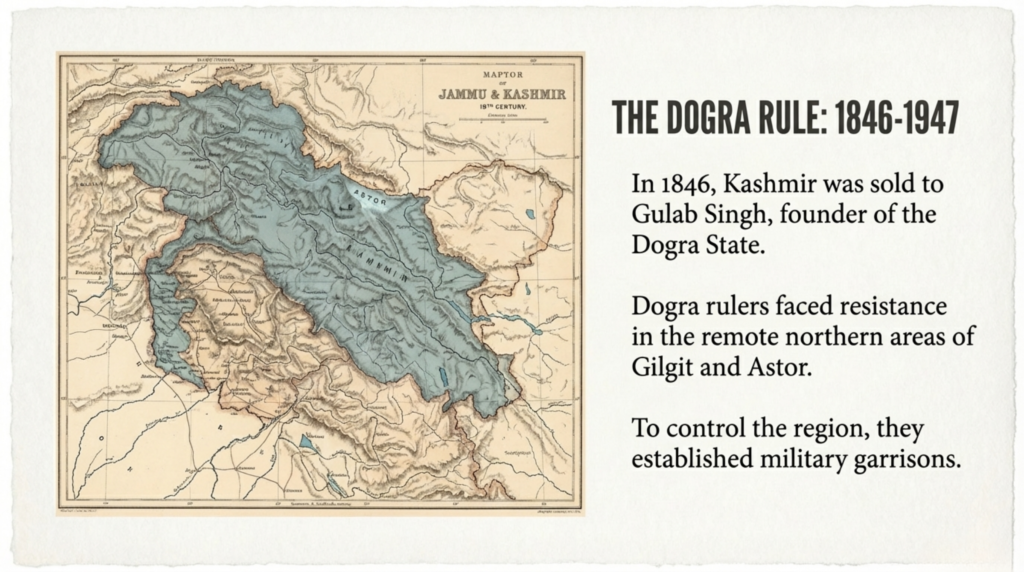
The historical turning point occurred in 1846, when Kashmir was sold to Gulab Singh, establishing the Dogra State of Jammu & Kashmir. Following this transfer of power, the Dogra rulers faced sustained opposition in the northern regions of Gilgit, Astor, and Chitral, a continuation of the resistance those populations had previously shown to the Sikh-Rulers. To quell this unrest and secure these territories, Gulab Singh’s administration established military garrisons in the forts of Astor and Gilgit, and, critically, stationed a considerable force in the small valley of Bawanji, known today as Bunji.
The rationale for the ‘Kar-Begar’ system stemmed from the extreme difficulty of maintaining these remote outposts. These mountainous areas were non-motorable, cut off from Kashmir, and enclosed by glacial peaks. Lacking roads and exposed to perpetually harsh weather, the garrisons required a constant stream of rations, weaponry, and other necessaries of life. With no other transport available, the Dogra state identified forced human labour as its solution. This confluence of military ambition and unforgiving geography did not merely create a logistical problem; it created the political justification for a system of forced labour that would become a defining feature of Dogra rule and a tool for the subjugation of the Kashmiri peasantry.The Mechanics of the Kar-Begar System
The ‘Kar-Begar’ system was not an ad-hoc measure but a deliberately structured and discriminatory institution of the Dogra state. Its operational details reveal a calculated cruelty designed to exploit a specific segment of the population for the state’s military ends. This section deconstructs the mechanics of the system to expose its institutionalized inhumanity.
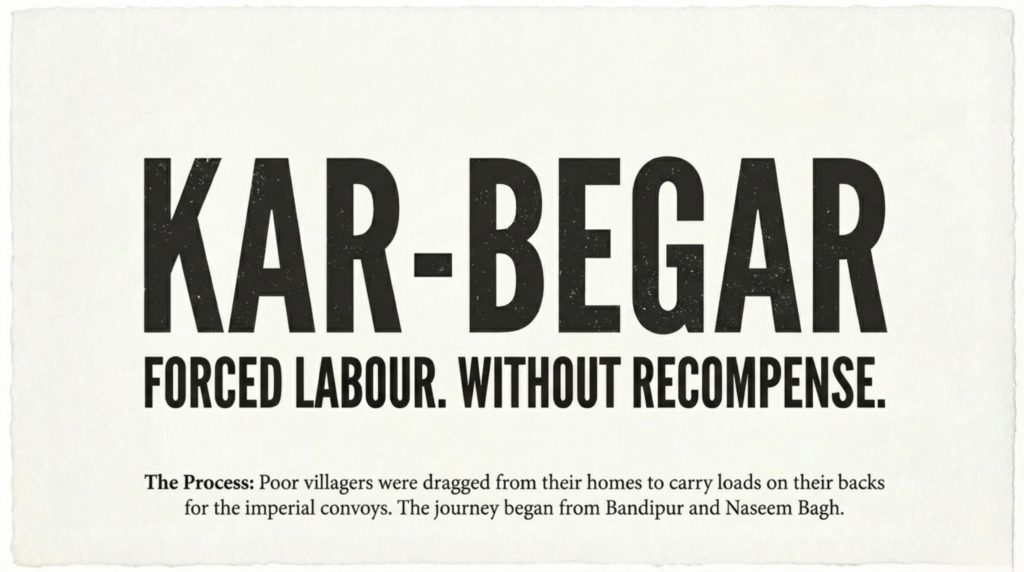
At its core, ‘Kar-Begar’ was explicitly defined as “FORCED LABOUR without recompense.” It was an official practice that denied its victims both wages and basic human dignity. The logistics of the system were ruthlessly efficient:
- Conscription Points: Poor villagers, known as collies, were forcibly dragged from their homes and collected at designated points, primarily Bandipur and Naseem Bagh.
- The Labourers’ Burden: These men were compelled to carry heavy loads of supplies and weaponry on their backs, accompanying the “IMPERIAL CONVOY” on the treacherous journey to the far-off garrisons.
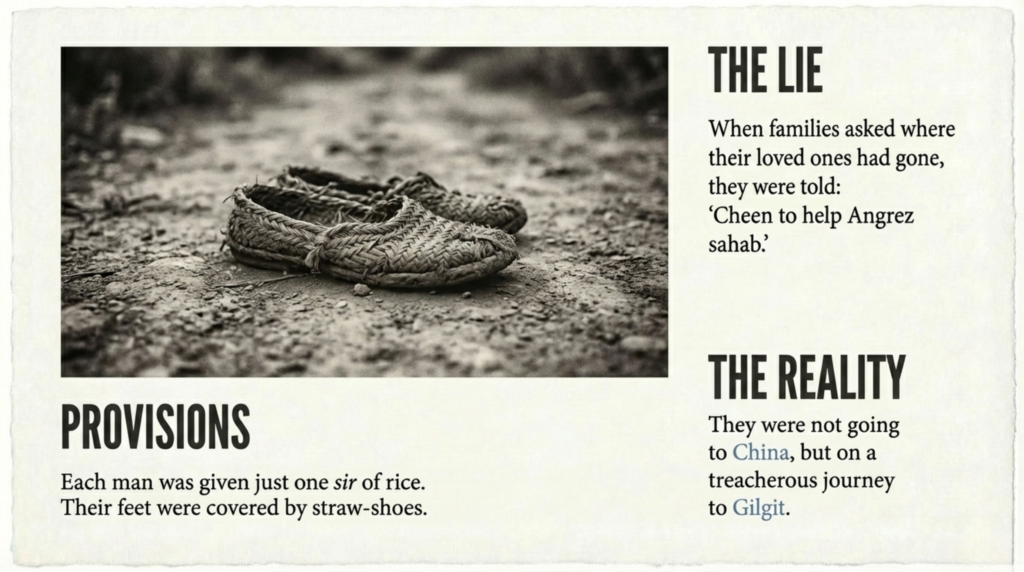
- Meager Provisions: The state provided a shockingly inadequate ration to sustain the labourers, known as begaris. Each man received “Just one sir of rice” for his sustenance on the arduous trek.
- Inadequate Attire: The miserable condition of the labourers was evident in their clothing. They were so ill-equipped for the journey that their feet were often covered only by “straw-shoes.”
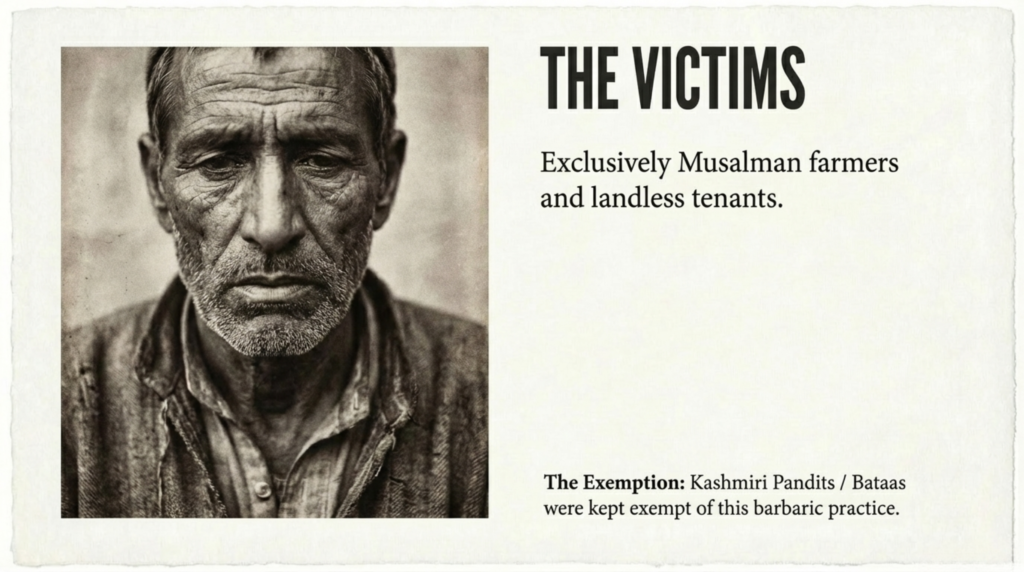
This calculated neglect was not merely a cost-saving measure; it was a fundamental component of the system’s lethality, ensuring that only the hardiest could survive the journey and rendering the conscription a de facto death sentence for many. Furthermore, this barbaric practice was discriminatory in its application. Historical records state unequivocally that it was the “Musalman farmers” who were exclusively targeted for this service, while “Kashmiri Pandits/ Bataas were kept exempt.” This selective application ensured that the burden of sustaining the state’s military ambitions fell upon a single, vulnerable community, transforming the system into an instrument of targeted oppression.
The Vicious Cycle: Economic Ruin and State Deception
The ‘Kar-Begar’ system was strategically intertwined with the agrarian economy in a manner that guaranteed the economic devastation of the peasantry. The timing of the forced conscription was a machination engineered not merely for transport, but as a mechanism that ensured economic collapse and perpetuated the vulnerability of the targeted farmers, trapping them in a cycle of debt and despair.
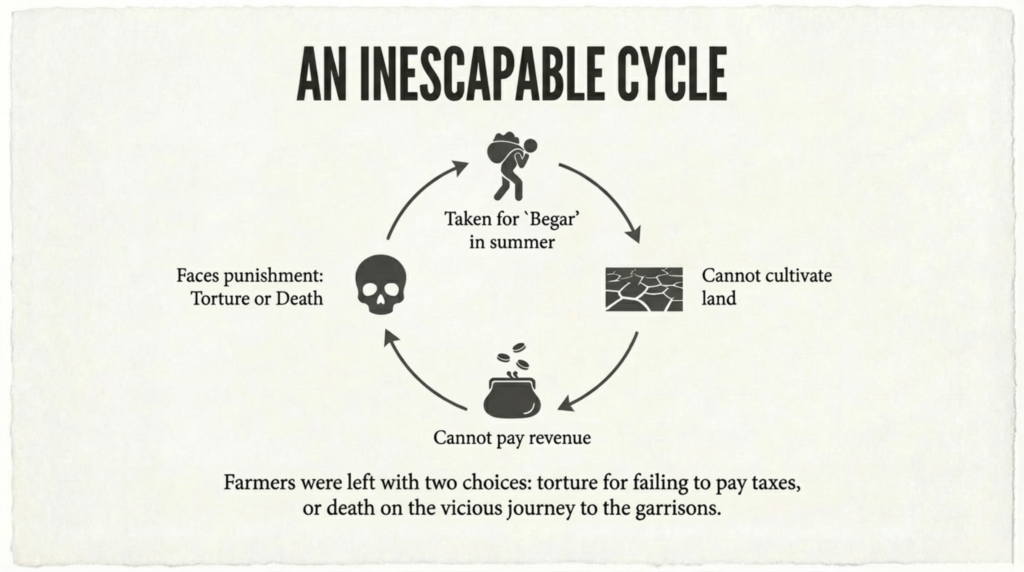
The system’s most ruinous economic impact stemmed from its timing. Farmers were taken for Begar during the summer months, the critical period for cultivation. By being forcibly removed from their lands, they were rendered unable to farm, which in turn made it impossible for them to generate the income needed to pay the heavy taxes demanded by the state. This created an inescapable dilemma: suffer torture at the hands of the revenue collectors—who, the historical record notes, were “invariably Kashmiri Pandits”—or face near-certain death on the vicious journey to the Gilgit garrisons. This detail illuminates how the system not only exploited but also exacerbated inter-communal tensions for the benefit of the state.
Compounding this economic ruin was a layer of state-sponsored deception. Officials deliberately created “total wrong impressions” in the minds of the victims’ loved ones. They were led to believe their loved ones had embarked on a noble mission to “Cheen” (China) to assist the “Angrez sahab” (Englishmen), a deliberate fiction that masked a brutal reality with a veneer of imperial service. This official deceit masked the horrific reality of the journey, a journey whose engineered economic hardship was matched only by its horrifying physical toll.
The Human Toll: A Journey of “Certain Death”
Beyond the systemic analysis of its mechanics and economic consequences, the lived reality of the ‘Kar-Begar’ system was one of unimaginable human suffering. Historical accounts paint a harrowing picture of the forced marches, documenting the profound human cost that cemented the phrase ‘Bawanjan Barun’ in the collective consciousness of Kashmir.
The journey to the Gilgit, Astor, and Bawanji garrisons was a veritable death march. Farmers were forced to trudge for months through “wearisome marches” across “arid” lands. Thinly clad and ill-fed, they perished from hunger, thirst, and exposure to the extreme cold on the “snowy passes.” The mortality rate was so catastrophic that it became a common understanding that, as one account notes, “when a man was seized for” this duty, his family “will never see him more.” These were not criminals being taken to a notorious prison, but ordinary men forced to service an army garrison.
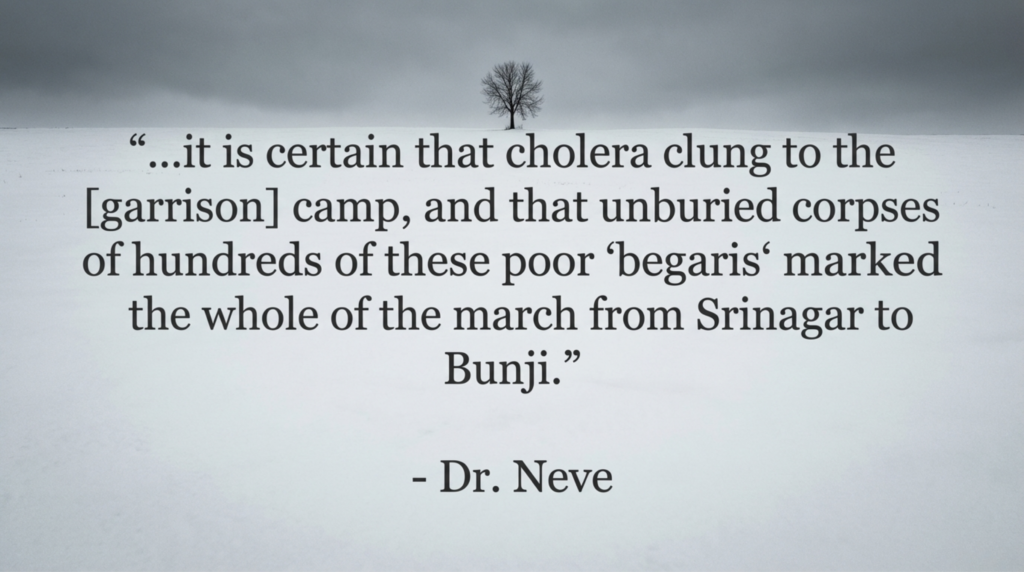
Dr. Neve’s 1888 eyewitness testimony from Islamabad provides a chilling tableau of this state-sanctioned dread. He witnessed a “farewell service” for nearly 1,000 conscripts where the “loud was the sobbing” of families testified to the journey’s known lethality, while the men themselves sought solace in “Ramzan penitential psalms” as if preparing for martyrdom. His account confirms that a cholera outbreak “clung to the [garrison] camp,” and provides the final, damning evidence of the system’s human cost: the “unburied corpses of hundreds of these poor ‘ begaris ‘” that served as gruesome mile-markers along the entire route from Srinagar to Bunji. It is this immense and documented human suffering that lies at the core of the idiom’s deep and lasting resonance.
Conclusion: From Forced Labour to Enduring Folklore
‘Bawanjan Barun’ is far more than an idiom; it is a linguistic scar preserving the memory of institutionalized oppression during a dark chapter in Kashmir’s history under Dogra rule. It serves as an oral monument to a system that defined the lives of Kashmiri Muslims for a century, encapsulating the terror of a state policy that equated conscription with a death sentence.
This monograph has demonstrated that the ‘Kar-Begar’ system was a multifaceted instrument of oppression. Arising from military imperatives inherited from the Sikh era, it was executed with calculated discrimination against Muslim farmers. It was designed not only to supply remote garrisons but also to create a vicious cycle of economic ruin that left the peasantry perpetually indebted and vulnerable. Ultimately, as eyewitness accounts attest, its human cost was staggering, with thousands perishing on the deadly routes to Gilgit, Astor, and Bawanji.
The persistence of this phrase in the Kashmiri language serves as an indelible memorial to the thousands who were lost on those snowy passes and arid trails, functioning as a living archive of state-sponsored brutality.