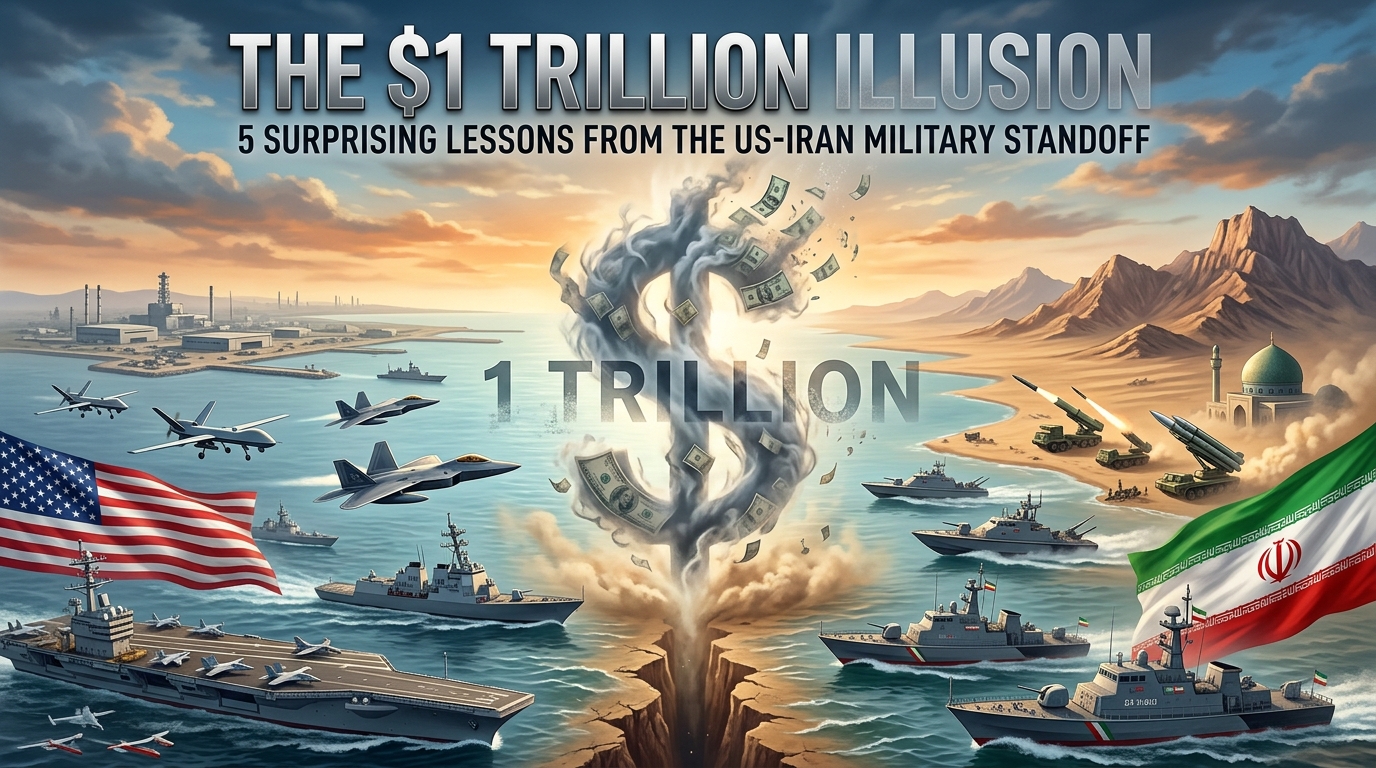
The $1 Trillion Illusion:

5 Surprising Lessons from the US-Iran Military Standoff
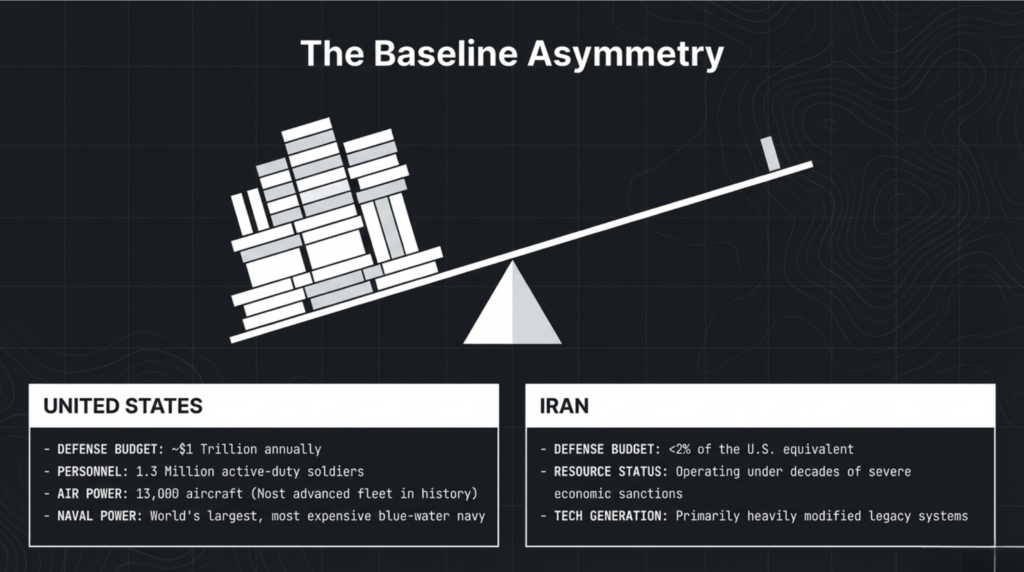
For decades, the United States has operated as the world’s solitary superpower, a status anchored by an annual military budget now hovering near $1 trillion. This staggering investment sustains 1.3 million active-duty personnel, a fleet of 13,000 aircraft, and a navy that has historically served as the ultimate arbiter of global trade and security. From space-based surveillance to advanced cyber-warfare, the U.S. arsenal is often presented as the pinnacle of human engineering.
Yet, in the current high-stakes standoff with Iran—a nation that has weathered decades of crushing sanctions and maintains a defense budget less than 2% of the Pentagon’s—the $1 trillion machine is stalling. The cracks in this facade are not mere accidents; they are systemic failures of a doctrine that values price tags over pragmatism. As Washington grapples with an adversary that prioritizes “smart thinking” over sheer spending, the world is witnessing a David vs. Goliath reality check that calls into question the very utility of modern “war toys.”
Why is the most expensive military in history struggling to contain a mid-tier power? The answer lies in five critical lessons that are forcing a global update to the art of war.
1. The “Invisibility” Cloak Has a Heat Problem
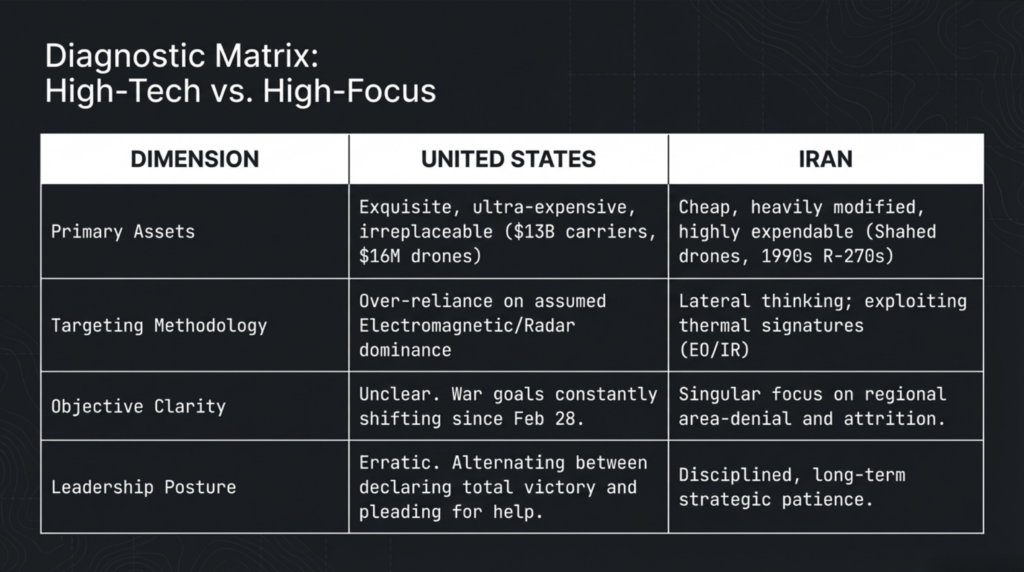
The F-35 stealth fighter was marketed as the ultimate “invisible” predator, a trillion-dollar program designed to evade electromagnetic radar through sophisticated geometry and absorbent materials. However, the events of March 19th delivered a masterclass in technological hubris. Just hours after Donald Trump declared “complete air domination” over Iranian airspace, Tehran released footage of a direct hit on an F-35.
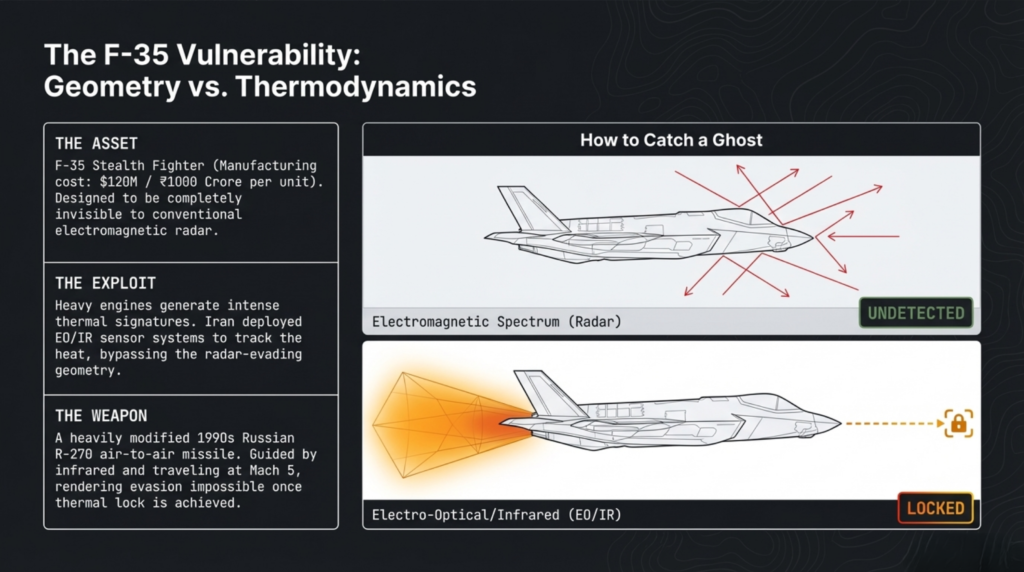
The technical irony is biting: while the F-35 is designed to hide from radar waves, its massive, high-performance engine remains a screaming beacon in the infrared spectrum. Iran bypassed American stealth by deploying Electro-Optical Infrared (EOIR) sensors. Instead of looking for a radar reflection, they tracked the jet’s heat signature—an Achilles’ heel that no amount of specialized shaping can fully mask.
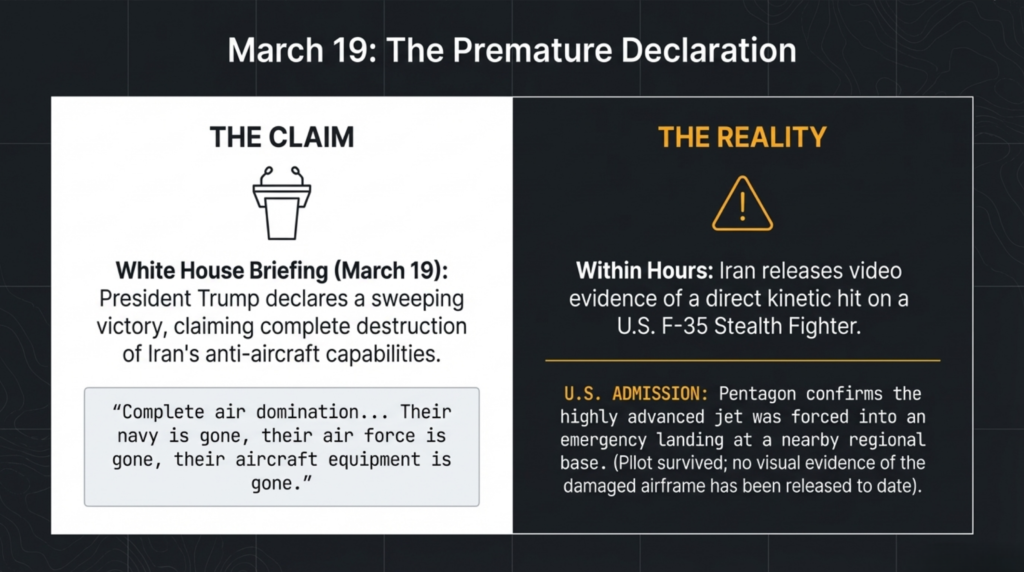
The disparity in cost and age is equally staggering. The ~$120 million aircraft was reportedly crippled by a modified Russian R-270 missile, a piece of 1990s-era technology. This isn’t an isolated incident; if current claims hold, this marks the fourth American air superiority fighter lost in this theater this month, following three F-15s previously dismissed as “friendly fire” casualties. As one analyst noted, for the U.S. military, this is “perhaps the most shameful moment of this war.” The global doctrine of stealth-priority is effectively dead; if a 30-year-old missile can find the most advanced jet in the world, the “invisibility cloak” is officially compromised.
2. The $200 Million Drone Graveyard
While Washington touts its aerial supremacy, the reality in the skies over the Middle East has become a graveyard for the MQ-9 Reaper program. In a mere three-week span, the U.S. has lost approximately 12 of these high-tech drones, totaling roughly $200 million in hardware.
- Internal Admissions: The failure of the Reaper was predicted by the Pentagon itself. In 2020, the U.S. Air Force actually halted production of the MQ-9, admitting the platform was too slow and non-stealthy to survive in contested airspace against a sophisticated adversary.
- The Illusion of Domination: Despite Trump’s claims that Iran’s anti-aircraft systems were “gone,” these “redundant” drones continue to be plucked from the sky by the very defenses they were supposed to have neutralized.
The lesson here is one of asymmetric reality: billion-dollar drone programs designed for low-intensity conflicts are becoming expensive liabilities in a true peer-to-peer or mid-tier standoff.
3. When Billion-Dollar Shields Go Blind
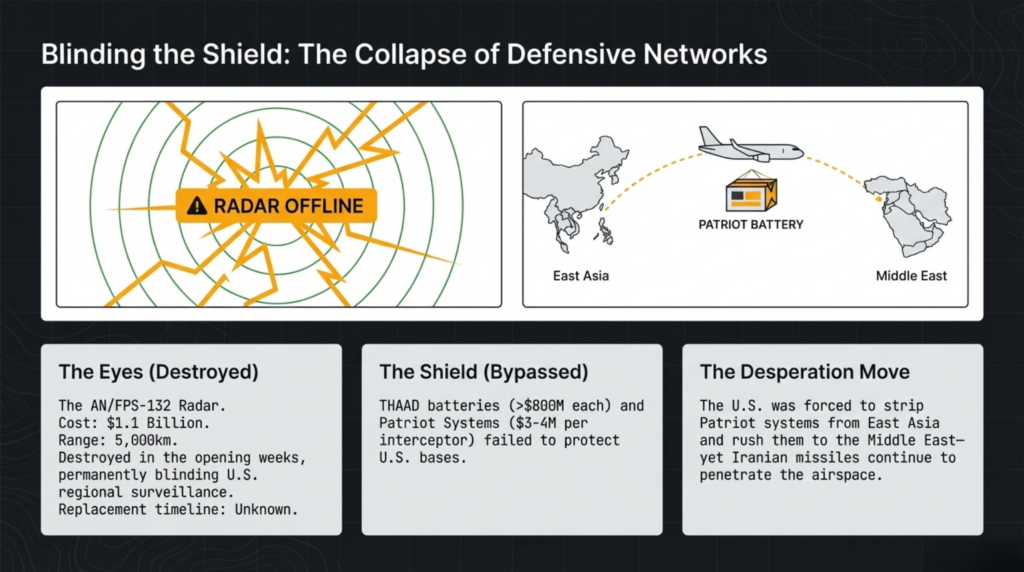
The American strategy in the Middle East relies on “shields”—the THAAD and Patriot missile defense systems. These are designed to protect allies in Israel and the Gulf from ballistic threats, but a shield is only as good as the eyes that guide it. In the opening weeks of the conflict, Iran focused its strikes on “plucking out the eyes” of the U.S. military grid.
The most devastating blow was the destruction of the AN/TPY-2 radar. Valued at $1.1 billion and capable of scanning a 5,000 km radius, its loss has effectively blinded U.S. interceptors. Crucially, the source context suggests the U.S. has “no idea” when or if this system can be rebuilt or replaced. This blindness has created a “Pacific trade-off,” forcing the U.S. to scramble and relocate Patriot systems from East Asia to the Middle East, actively weakening the American position against China to fill the gaps in the Gulf. The shield hasn’t just been cracked; it has been bypassed.
4. The Retreat of the Floating Fortresses
For a century, the Aircraft Carrier Strike Group was the undisputed symbol of American power projection. Today, these “floating fortresses” are in a state of defensive retreat.
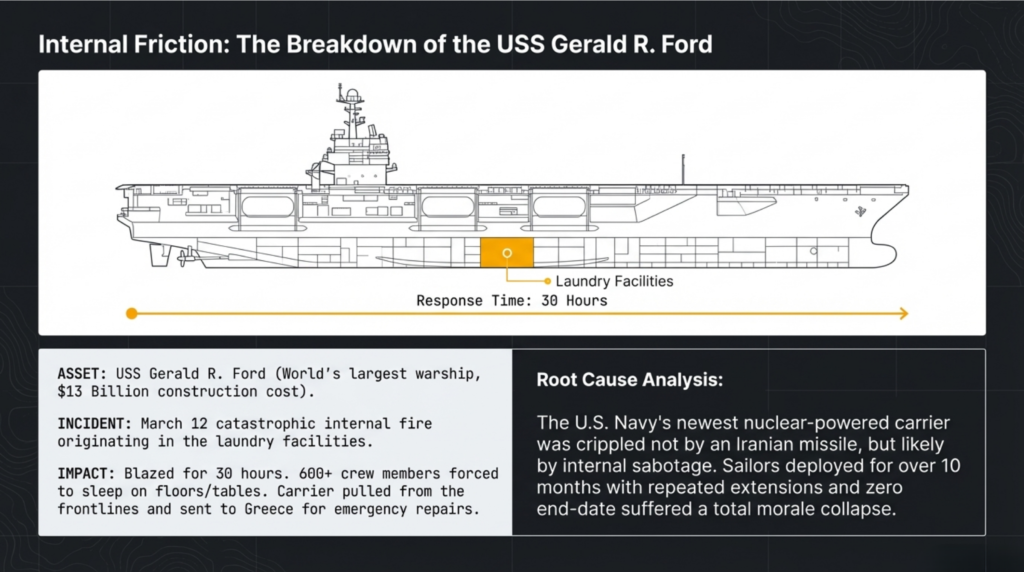
The situation aboard the USS Gerald R. Ford, the world’s largest and newest $13 billion nuclear carrier, highlights a deeper crisis of human capital. Sidelined by a 30-hour laundry room fire, the official narrative cites mechanical failure, but a more provocative theory has emerged: sabotage. Reports suggest that sailors, exhausted by a 10-month deployment and facing an indefinite extension, may have intentionally started the fire to force a return to port.
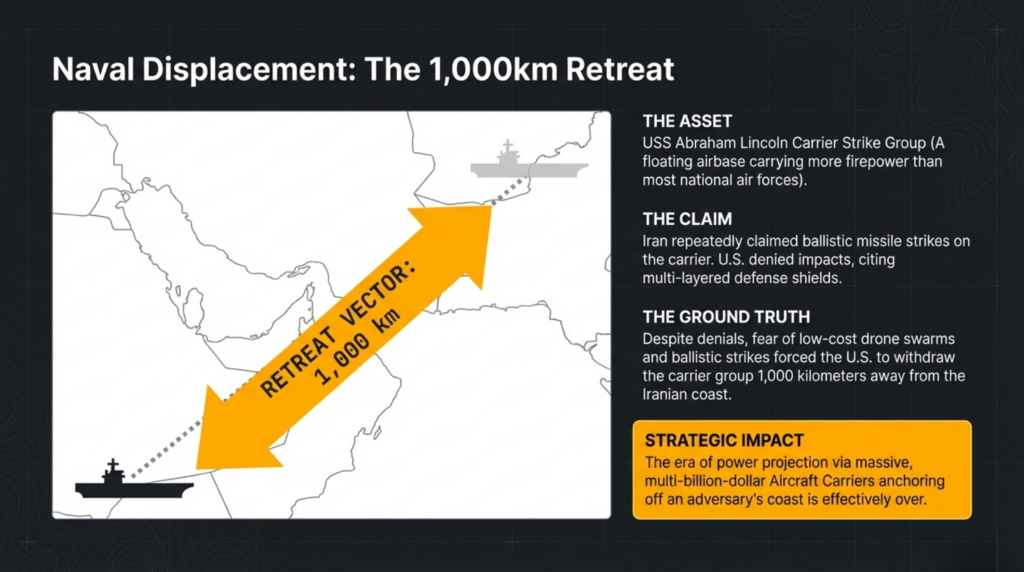
Meanwhile, the USS Abraham Lincoln has reportedly fled 1,000 km away from the Iranian coast. Despite U.S. claims of “multi-layered defense,” the carrier moved out of range of Iranian ballistic missiles, effectively surrendering its ability to project immediate power. When the world’s most advanced navy is too afraid to bring its primary assets within striking distance of a sanctioned nation, the era of carrier-based hegemony is nearing its end.
5. The “Commander-in-Chief” Paradox
The final, and perhaps most damning, lesson is that a $1 trillion arsenal cannot compensate for a lack of strategic discipline. The conflict has exposed a “Commander-in-Chief Paradox,” where the U.S. military’s technical prowess is undermined by inconsistent directives from the White House.
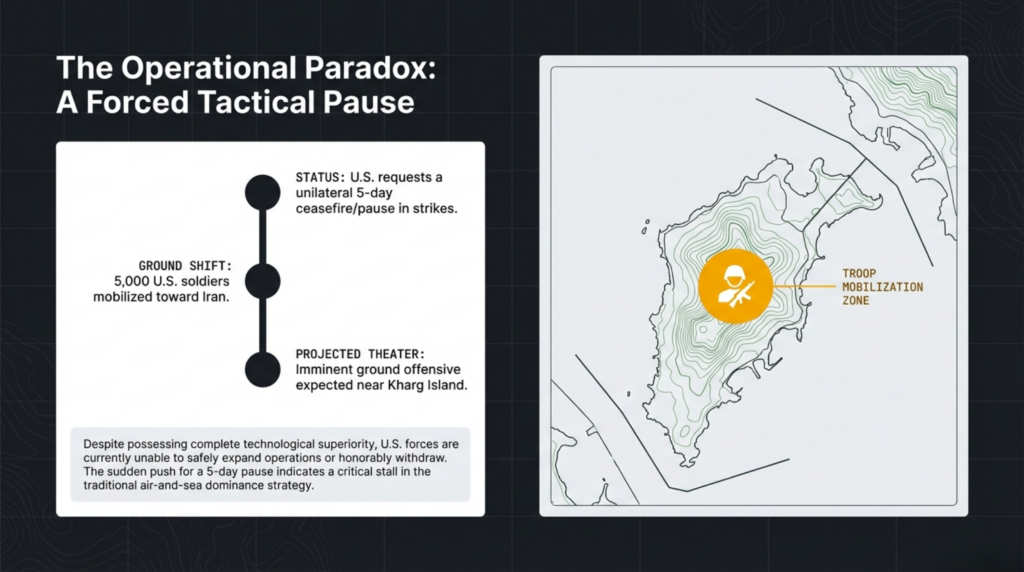
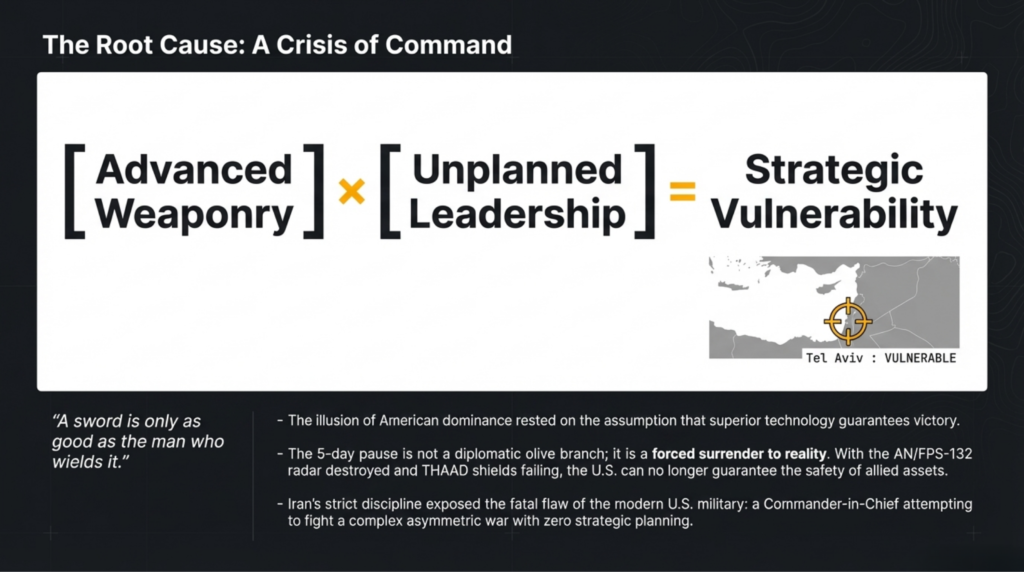
President Trump’s messaging has been a study in temporal irony. He declared “complete air domination” on March 19th, only to have an F-35 hit hours later. He has fluctuated between threatening total destruction of power plants and unilaterally announcing a 5-day “pause” in offensive operations. This pause is not a gesture of peace; it is a tactical deficit. Analysts argue the pause was offered because the U.S. realized that if ballistic attacks continue for five more days, there will be nothing left of the defense grid in Israel and the Gulf. As the saying goes, “A sword is only as good as the man who wields it.” Without a clear war goal, the U.S. is left holding a very expensive, very blunt sword.
Closing Thought: A Permanent Shift in Doctrine
The five-day “pause” currently on the table is less of a ceasefire and more of a desperate attempt to regroup a compromised defense architecture. Iran’s refusal to negotiate until a total U.S. exit from the Gulf signals a permanent shift in the regional power balance.
This standoff serves as a global wake-up call, forcing every nation to update their war doctrine. We are moving away from an era defined by stealth-priority and massive, centralized assets like aircraft carriers. The future belongs to those who can master heat-masking, mobile missile batteries, and “smart thinking” over sheer budgetary bulk. The $1 trillion illusion has been shattered, leaving a haunting question for the future of Western military thought: can high-tech spending ever truly replace the necessity of strategic discipline and a focused plan? As the U.S. seeks an honorable exit, the world is learning that in modern warfare, the most expensive toys are often the easiest to break.